Beyond Fast Response: What C-Store Operators Really Need From Customer Support

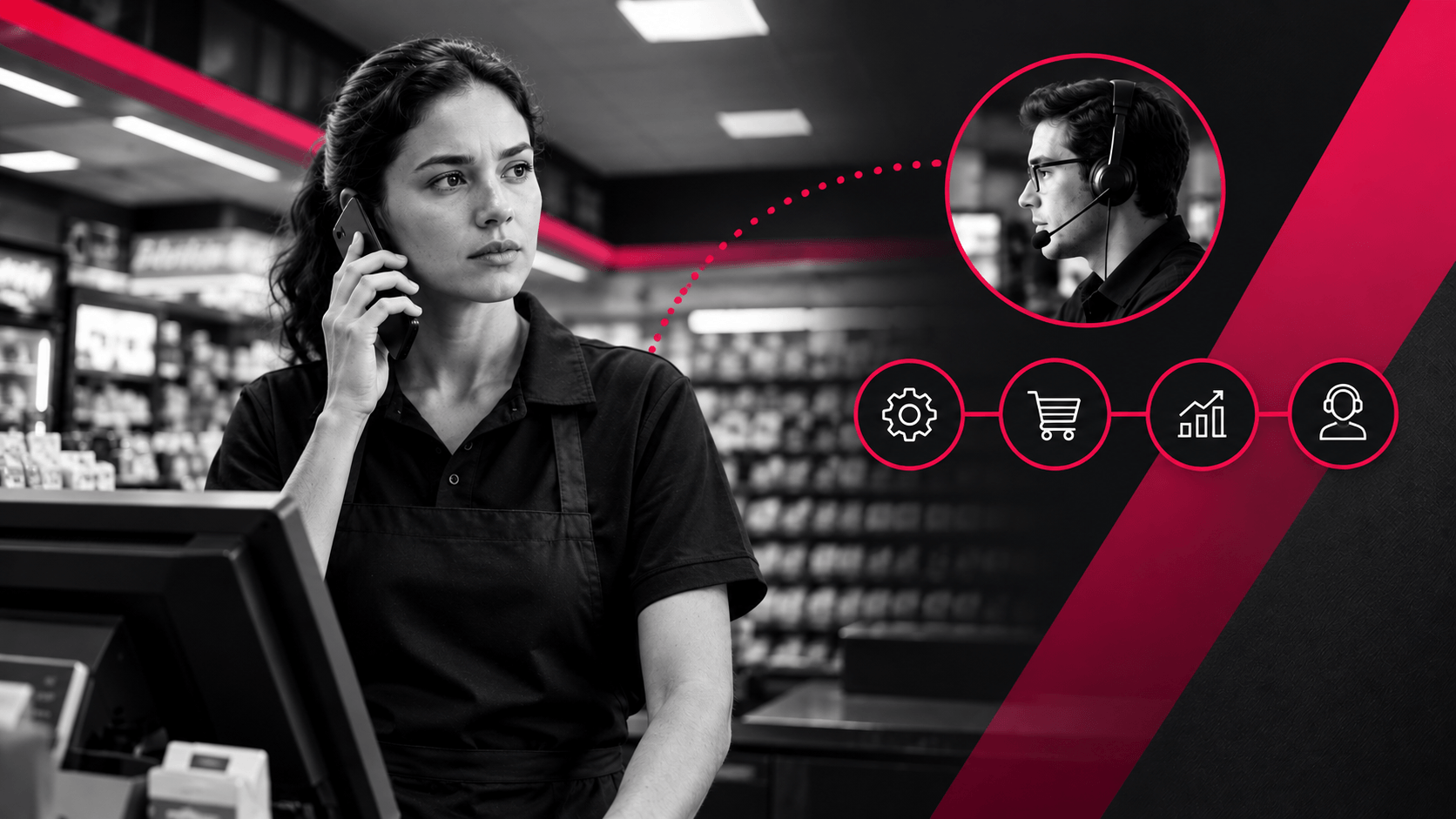
A promotion fails at the register during a busy shift. A customer notices the price is wrong. The manager checks the system, can't find the cause, and calls support.
The store is still open. The registers still work. But now the manager is stuck on hold, explaining the same problem to another person while customers wait and the promotion continues to misfire.
An hour later, the immediate disruption may be over. The management time is not coming back, the customer experience has already taken a hit, and the underlying issue may still need investigation.
This is where MostEdge takes a different approach. Its support model is designed to connect operators with human specialists who can understand the store context, investigate what happened, and work toward a resolution not simply create another ticket or transfer the conversation.
Because for a C-store operator, support isn't just about getting an answer. It's about getting the operation moving again.
Why Customer Support Matters in C-Store Operations
According to the 2026 NACS / TDLinx Convenience Industry Store Count, there are 151,975 convenience stores in the United States.
What matters most is that 95,672 stores, or 63% of all convenience stores, are operated by companies with 10 or fewer locations. These are not billion-dollar chains with large in-house IT teams. Many are independent operators or small multi-store businesses where owners also manage daily operations and vendor relationships.
The U.S. convenience-store industry recorded $817.5 billion in total sales in 2025, and the average store processed about 1,484 transactions every day. With this level of daily activity, POS and back-office systems play an important role in store operations. Even a small system problem can cost time and create disruption, even if it doesn't shut down the entire store.
Even a smaller issue consumes employee time and management attention, and for a multi-store operator, that adds up across every site.
The Difference Between Answering and Investigating
Three things are often treated as interchangeable in customer support: answering, investigating, and resolving. They are not the same.
- Answering explains how a feature works.
- Investigating figures out what actually happened.
- Resolving takes the action that fixes it.
Consider a manager who reports that the system shows 50 units in stock, but the physical count is 42.
A generic response explains how to make a manual adjustment that answers a question but doesn't investigate.
Meaningful support asks when the discrepancy started, whether there was a recent delivery, whether returns were processed, or whether synchronization failed between the register and the back office.
The same applies to a price that doesn't match the shelf or a promotion that won't fire. The cause could be the price book, a promotion rule, or a sync issue, and it takes investigation, not a generic answer, to know which.
Why the First Person You Reach Matters
The first support contact can determine whether an operational problem starts moving toward a solution or simply becomes another ticket in the queue.
At MostEdge, we believe that person should be a qualified starting point. They don't need every answer memorized, but they should understand the store's context, ask useful diagnostic questions, recognize where the problem may originate, and either resolve it or begin a meaningful investigation.
That matters when a pricing, inventory, or transaction issue is affecting a live store. Sending the operator elsewhere without gathering the right information simply adds another handoff and another interruption to the manager's day.
SQM Group's contact-center benchmarking found a 47% difference in top-box customer satisfaction between issues resolved in one call and those requiring four or more. The research isn't C-store-specific, but the underlying mechanism is relevant: repeated contacts create friction when an operational problem remains unresolved.
For operators, the question isn't simply who answers first. It's whether the first person can actually move the problem forward.
Measure Resolution, Not Just Response
Once the quality of the first contact is considered, the next question is how operators should judge whether support actually worked.
For a convenience-store operator, fast replies mean little if the pricing, inventory, or transaction problem remains unresolved and continues disrupting daily store operations.
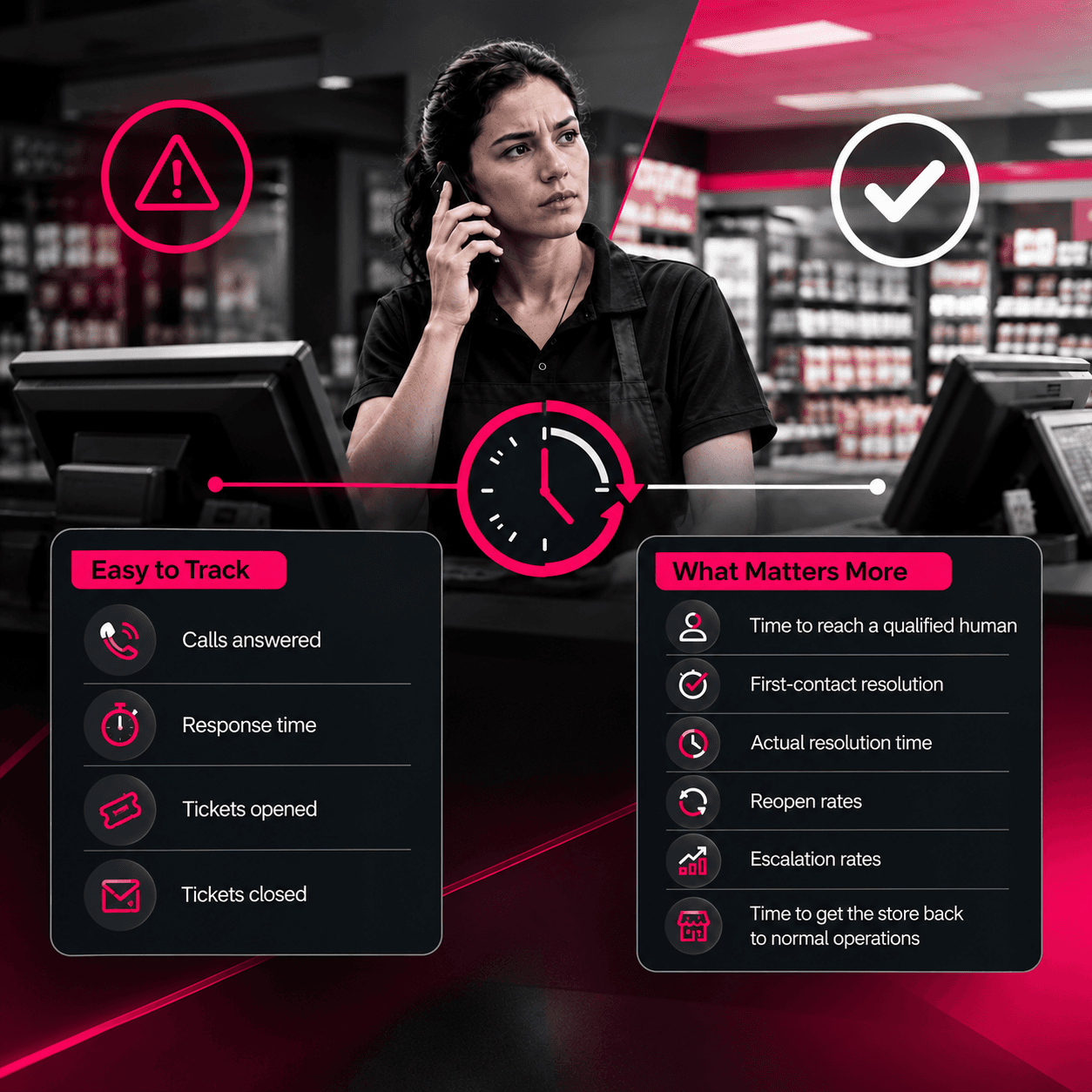
Customer Support is often measured by what's easy to track:
- Calls answered
- Response time
- Tickets opened
- Tickets closed
Stronger measures look at what happens after contact:
- Time to reach a qualified human
- First-contact resolution
- Actual resolution time
- Reopen rates
- Escalation rates
- How long it takes to get the store back to normal operations
The goal shouldn't be answering faster for its own sake. It should be shrinking the gap between when a problem starts and when it's genuinely resolved.
Where MostEdge's Customer Support Model helps C-store
MostEdge gives convenience-store operators multiple ways to reach support phone, chat, Tawk.to messaging, and email. The model is built around access to human service specialists rather than making automation the only path to help.
That matters because store issues do not always happen during convenient business hours. A pricing problem, transaction issue, or system disruption can affect operations at any time. MostEdge provides 24/7 support, giving operators a way to reach the support team when problems occur.
Support requests can be tracked through tickets, giving the team a record to work from when an issue requires continued investigation. This gives the support team a clearer history when an issue requires continued investigation rather than a single response.
The goal is straightforward give operators a real path to help, keep the issue moving, and make it easier to follow a problem through to resolution.
Phone and chat queues can still occur during high-volume periods, so 24/7 availability should not be presented as a guarantee of instant connection. The value is having support available when the store actually needs it.
Conclusion of customer service
For convenience-store operators, technology support is ultimately about protecting the operation from unnecessary disruption. The right provider should make it easier to keep stores running, investigate unusual issues, and give operators confidence that problems will not simply disappear into a ticket queue.
MostEdge approaches support with that operational reality in mind, combining access to human specialists with multiple support channels and around-the-clock availability.
The real standard isn't whether a provider answered quickly. It's whether the operator can trust that provider to help keep the business moving when something goes wrong.

7 Common Vendor Invoice Mistakes That Impact Profitability
5 Inventory Management Problems That Start Before a Product Reaches the Shelf
Inventory Accuracy: How to Make Better Decisions With Store Inventory Data
Explore More

Trusted By Many
Become A Part Of It