blog

The Self-Checkout Kiosk Surge: Why Convenience Stores Are Driving the Next Decade of Retail Automation
The Self-Checkout Kiosk Surge: Why Convenience Stores Are Driving the Next Decade of Retail Automation

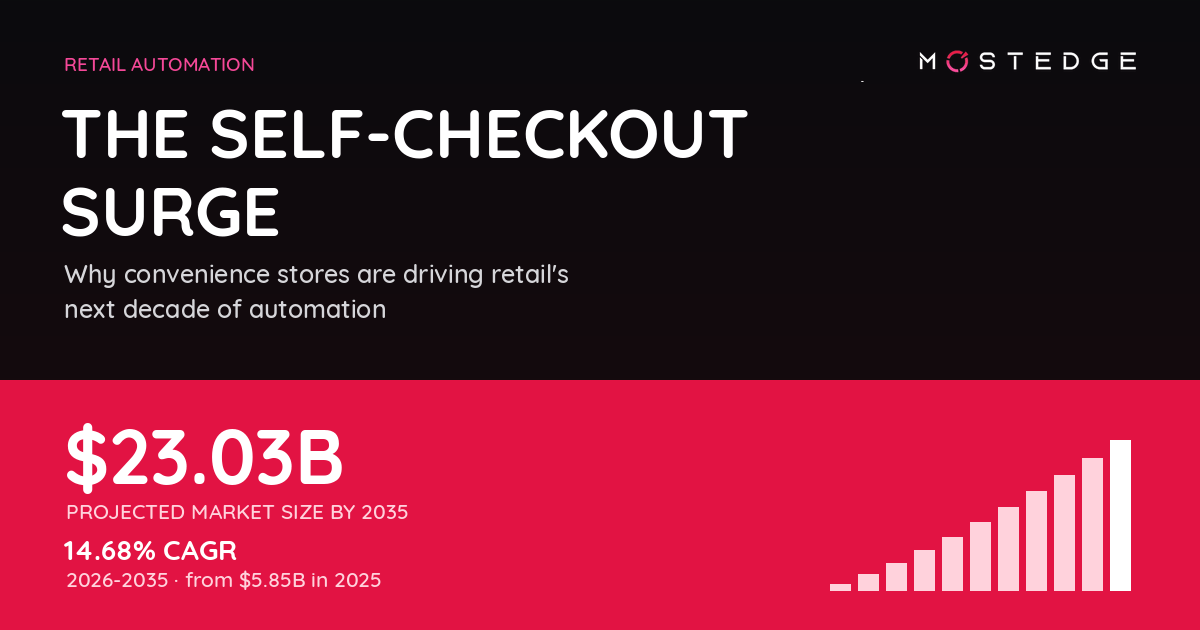
Retail self checkout is moving from a nice-to-have to a default expectation, and a new SNS Insider market analysis puts numbers behind that shift: the global self-checkout system market was valued at $5.85 billion in 2025 and is projected to reach $23.03 billion by 2035, a compound annual growth rate of 14.68% across the 2026–2035 forecast window.
That's a decade-long bet that customer self-service becomes the default checkout mode, not the exception — and convenience stores and fuel stations sit right at the center of it, named in the same report as one of the fastest-growing segments pushing the curve upward.
Here's what's driving that number, and what it means for a channel running on thinner staffing than almost anywhere else in retail.
Fast facts from the report:
- Global market: $5.85B (2025) → $23.03B (2035) at a 14.68% CAGR
- Fixed kiosks: 73.2% of 2025 revenue; mobile self-checkout is growing fastest
- Convenience stores and fuel stations: among the fastest-growing adopter segments
- North America leads today; Asia Pacific — including India — grows fastest through 2035
Why the Growth Curve Is Bending Upward
Behind the topline number is a simple set of forces arriving at once: transaction volume climbing, hiring pools shrinking, and customer patience for a line wearing thin. Self-checkout systems answer that math directly, pairing computer vision and machine learning with cloud-based store management so one associate can oversee a bank of kiosks at once.
That drives labor efficiency and customer convenience together, even though most deployments still lean on staff for exceptions and the interactions that need a human touch.
Self-checkout has stopped being a novelty and become ordinary store technology, and nowhere is that staffing math more acute than in convenience stores and fuel stations — exactly why they're one of the fastest-growing corners of the entire market.
Convenience Stores and Fuel Stations Are Where the Action Is
These formats run lean by design — often one employee covering the register, the coffee station, and the forecourt at once — making self-checkout one of the more visible labor shortage solutions retailers have reached for.
A compact self-checkout kiosk fits that reality in a way a supermarket-style bank of registers never could — for convenience store self checkout, the fit has to be right-sized in footprint, basket, and cost.
For operators facing retail staffing challenges, self-checkout isn't primarily a customer-experience upgrade — it's a workforce optimization move that also makes the store more pleasant to shop in, one piece of a broader operational efficiency and store productivity push. That "more pleasant to shop in" part is worth unpacking on its own.
Shorter Lines Are Only Half the Story
Most conversations about that experience start and end with speed, and it's a real win — the ability to reduce checkout lines during a lunch rush or an evening fuel stop means faster checkout, fewer abandoned baskets, and shorter tempers at the register. But queue management is just the entry point.
The bigger payoff is what happens to customer experience once transaction speed stops being a source of friction: shoppers who aren't standing in line have more patience for a loyalty prompt and a better last impression on the way out.
Shopper satisfaction in stores running self service checkout tends to reflect exactly that — less about the technology, more about giving people their time back. Faster and happier is easy to argue; whether it means fewer people behind the counter is where the conversation goes sideways.
Cashier vs. Kiosk Is the Wrong Debate
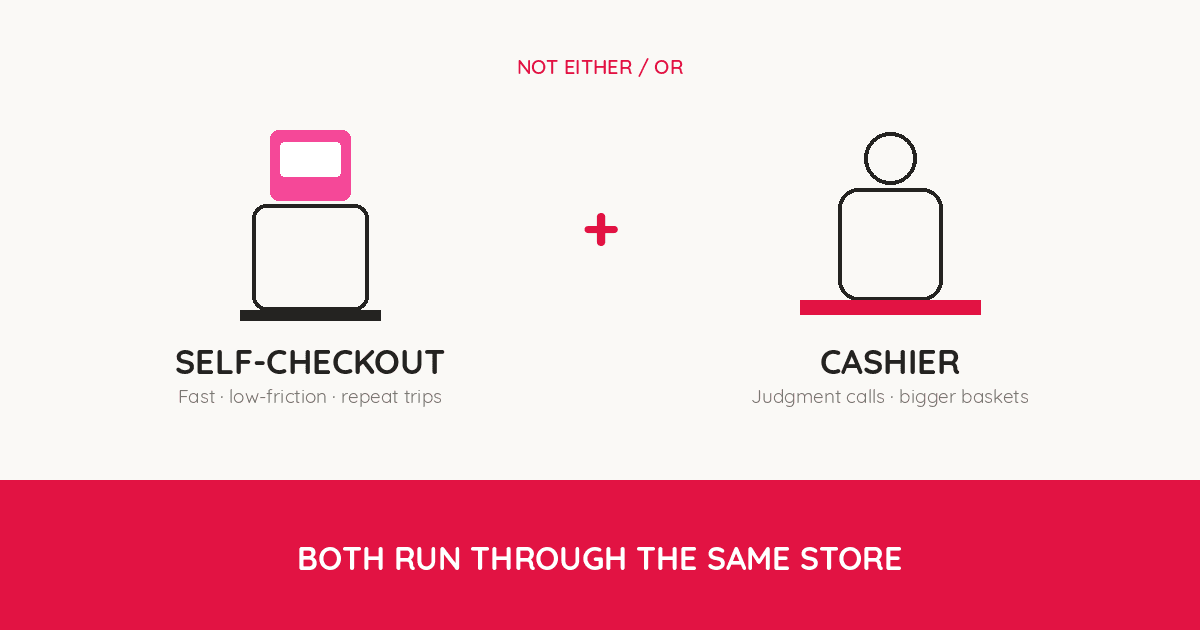
It goes sideways into a lively self checkout vs cashier argument, usually framed as choosing between automated checkout and human service. In practice, the retail operations that get this right don't pick a side — they blend both, using staff for judgment calls and cashierless retail for the fast, low-friction purchases that make up most convenience-store traffic.
Customer preferences bear this out: the same shopper who wants a fully automated exit on a coffee run might prefer a cashier for a bigger basket or a product question. Store efficiency shows up when both modes work together — which points to the real question: not kiosk or cashier, but what's running underneath either option.
The Software Underneath Is What Actually Matters
This is where self checkout software earns its keep. A kiosk is just a screen and a scanner until it's connected to something smarter — the layer MostEdge's Store X is built for, sitting underneath the hardware instead of competing with it.
Payment integration and POS run through Store X, real-time inventory sync runs through Stock 360, and loyalty integration runs through Loyalty 360, recognizing repeat customers at the register instead of a separate app tap.
Worth being candid, too: unmonitored lanes carry a known shrinkage risk, which is why operators pair kiosks with loss-prevention tools like WatchGuard rather than assume the machine polices itself.
Retail kiosk software that handles all of this well is what separates checkout automation that helps a store from checkout automation that just relocates the same friction — and once it's running cleanly, it's positioned to do more than keep the lights on.
Turning Checkout Into a Growth Channel
That "more" shows up right before payment, in the moment a busy cashier rarely has time for. Retail upselling technology built into the kiosk screen can surface a relevant add-on or a kiosk promotion tied to a loyalty account, nudging impulse purchases a shopper would likely have made anyway.
Done well, this kind of self checkout upselling doesn't read as an ad — it reads as the store remembering what the customer usually buys. The payoff shows up in basket size growth and, over time, in customer engagement numbers that have nothing to do with speed.
Self-checkout isn't only cutting costs — it's opening a revenue lane at the moment the sale happens, and that combination is what's pulling investment into the space across every region, just not at the same pace everywhere.
Where Self-Checkout Growth Goes Next
North America currently holds the largest share of the self-checkout market, the result of years of head-start investment in automation and payment infrastructure. But the fastest growth through 2035 is expected out of Asia Pacific, with India named specifically alongside China, Japan, and South Korea. That puts MostEdge, serving convenience retail.
Whether a store's biggest constraint is staffing, checkout speed, or getting a loyalty program to show up at the register, a self-checkout kiosk arrives with the software question already attached, not a footnote to sort out later.
That's the gap between today's $5.85 billion market and the $23 billion one a decade out decided store by store, right at the register where this conversation started.
More Retail Insights for Store Owners
Self-checkout is just one part of the technology and strategy reshaping modern retail. Explore these related insights on store growth, retail technology, and changing customer demand:


You Found a $10,000 Inventory Variance. What Should You Do Next?
Beyond Fast Response: What C-Store Operators Really Need From Customer Support

Back-to-School 2026 Shoppers Are Spending Differently—and Convenience Stores Have an Opening
Explore More
Trusted By Many
Become A Part Of It